Introduction
Slow cooking has held a steady place in home kitchens for decades, and for good reason. It turns tougher cuts of meat into something tender, lets busy households come home to a finished meal, and simplifies large-batch cooking for gatherings without demanding constant attention at the stove. As slow cookers have evolved, manufacturers have tried to solve two recurring frustrations: making enough food for a crowd, and getting that food from the kitchen to wherever it’s actually going to be served without a mess along the way.
The Hamilton Beach Stay or Go Extra Large 10 Quart Portable Slow Cooker (model 33195G) is built around exactly that second problem. It’s a large-capacity, manually controlled slow cooker with a locking lid system designed to keep contents secure during transport — whether that means carrying a pot of chili across the kitchen or driving it to a potluck a few miles away. This article walks through what the appliance offers, how people typically use cookers in this category, who tends to find this size and style useful, and what’s worth thinking about before adding one to a kitchen. The goal here isn’t to tell you it’s the right choice — it’s to give you enough grounded, practical information to decide that for yourself.
Key Features
10-Quart Oval Stoneware Crock
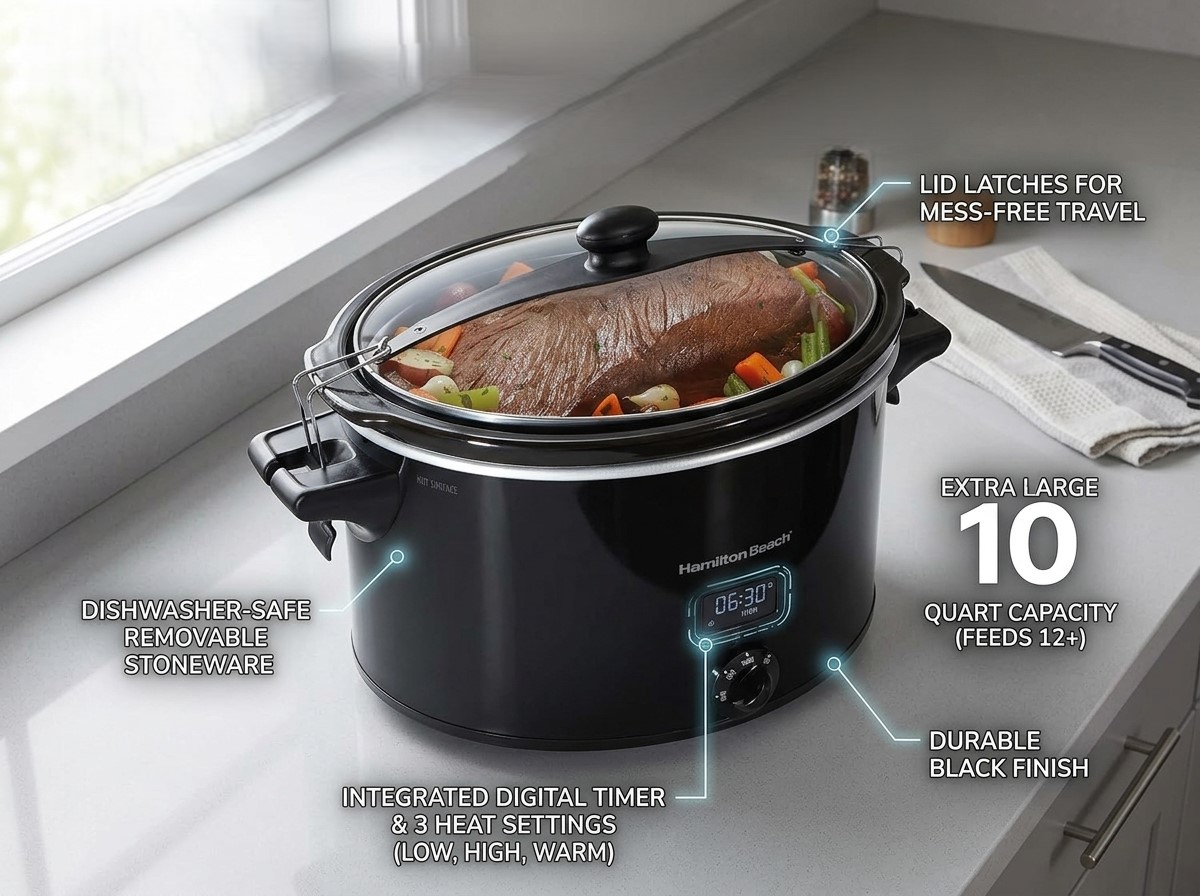
At the center of this slow cooker is a 10-quart oval stoneware insert, sized to accommodate larger cuts of food such as a whole turkey (up to roughly 10 pounds) or a bone-in roast (up to about 12 pounds). The oval shape, as opposed to a round crock, tends to suit long or irregularly shaped items better, which matters if you’re planning to cook something like a whole chicken, a rack of ribs, or a large roast rather than just soups or stews.
Three Manual Heat Settings
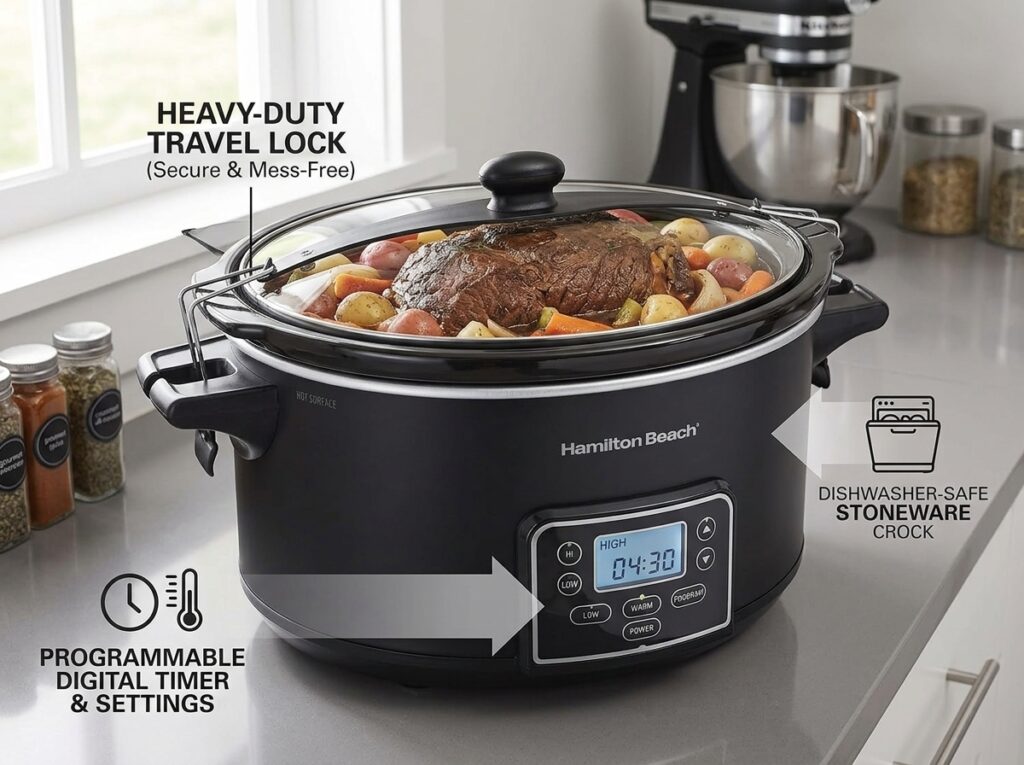
Rather than a digital control panel with programmable timers, this model uses a simple dial with three settings: Low, High, and Warm. The idea is straightforward — you choose Low or High depending on how much time you have and how the recipe is written, and once the food finishes cooking, you switch to Warm to hold it at serving temperature without continuing to cook it further. There’s no built-in timer or delayed-start function, so it operates more like a traditional slow cooker in that sense, with cooking time managed by the person using it rather than automated.
Clip-Tight, Locking Lid (“Stay or Go” System)
The defining feature referenced in the product name is the lid-locking mechanism. The lid clips down onto the handles of the crock, creating a tighter seal than a standard loose-fitting lid. This is intended to reduce the chances of liquid sloshing out or the lid shifting during transport — useful when carrying a hot, full crock to a dining table, into a car, or across a parking lot to a tailgate. It’s worth noting that “reduce spills” is a more accurate way to describe this than “spill-proof,” since a full liquid-based dish carried at an angle can still shift regardless of how tightly a lid clips down.
Full-Grip Carrying Handles
The exterior housing includes wide, full-grip handles positioned for two-handed carrying. Combined with the locking lid, this is meant to make it more manageable to lift and transport a heavy, hot cooker — something that matters given that a full 10-quart crock of food, plus the base unit, adds real weight (the unit itself weighs a little over 15 pounds empty, before food is added).
Dishwasher-Safe Components
Both the stoneware crock and the glass lid are labeled dishwasher-safe, which simplifies cleanup after use. The heating base, as with virtually all electric slow cookers, is not submersible and should be wiped down separately rather than washed with water.
Compact-for-Its-Capacity Footprint
Despite the large 10-quart capacity, the unit is designed with dimensions intended to remain reasonably manageable for storage — approximately 15.75 inches wide, 12.5 inches deep, and 11.5 inches tall. That’s still a sizable appliance, and anyone considering it should think about where it will live in a cabinet or on a counter, but it’s worth knowing the general footprint ahead of time.
450-Watt Heating Element
The cooker draws around 450 watts, which is fairly typical for slow cookers of this size. Slow cookers are generally designed for low, steady energy draw over long cooking periods rather than high, quick bursts of heat, which is part of why they can be more energy-efficient than an oven for certain long-cook dishes.
How It Can Be Used
A slow cooker of this size and style tends to get used in a few recurring ways, based on how the category is typically marketed and used:
Large-format meals for gatherings. The 10-quart capacity is aimed squarely at feeding a crowd — think a dozen or more people. This makes it a natural fit for holiday meals, potlucks, family reunions, and other events where a single dish needs to stretch across many plates. A whole turkey breast, a large batch of pulled pork, or a big pot of chili are all realistic uses for a crock this size.
Batch cooking and meal prep. Even outside of entertaining, some people use a large slow cooker to prepare food in bulk for the week ahead — a big batch of soup, shredded chicken, or beans that gets portioned into containers for later. The tradeoff is that a 10-quart crock is generally more capacity than a single household needs on a nightly basis, so this use case tends to suit people who specifically want to cook once and eat multiple times.
Transporting hot food to another location. This is the feature the product is built around. The locking lid and carrying handles are meant to make it more practical to bring a finished, hot dish somewhere else — a friend’s house, a tailgate, a church function, an office party — without needing to transfer the food into a separate travel container first.
Buffet-style serving. Because the Warm setting holds finished food at serving temperature without continuing to cook it, the cooker can double as a way to keep a dish ready to serve over an extended period, which is common at buffet-style gatherings where people come and go over a few hours.
Everyday slow cooking for larger households. For families or households that regularly cook for six or more people, a larger crock size can also just serve as the primary everyday slow cooker rather than something reserved for special occasions.
Who It May Be Suitable For
Given the size and feature set, certain kinds of households and use cases tend to align well with this type of appliance:
- Larger families who regularly need to prepare meals that serve six, eight, or more people at once.
- People who host — whether that’s holiday dinners, regular potlucks, or casual gatherings where a big shared dish is part of the plan.
- Anyone who frequently transports food, such as bringing dishes to work events, community functions, or family get-togethers, and wants a built-in way to reduce spill risk during the trip.
- Batch cooks and meal preppers who prefer to cook a large quantity at once and portion it out over several days.
- People who prefer manual, dial-based controls over digital programming — this model doesn’t include app connectivity, delayed start, or a built-in countdown timer, which some people find simpler and more intuitive, while others may miss those features.
On the other hand, this may be more capacity and size than needed for someone cooking primarily for one or two people, or for anyone with limited kitchen storage space, since a 10-quart oval crock takes up noticeably more room than a standard 4- to 6-quart round model.
Important Things to Consider
No single appliance fits every kitchen, so it’s worth thinking through a few practical points before deciding whether this size and style makes sense.
Storage space. A 10-quart oval cooker is a large appliance. Before purchasing, it’s worth measuring the cabinet, pantry shelf, or counter space where it would realistically be stored, since oval-shaped inserts don’t always fit neatly into spaces designed around round cookware.
Weight when full. An empty stoneware crock of this size already weighs a meaningful amount, and once filled with food and liquid, the total weight increases substantially. The carrying handles are designed to help with this, but it’s still worth being realistic about lifting and transporting a hot, heavy, liquid-filled container, particularly over stairs or uneven ground.
No digital timer or delayed start. Some newer slow cookers include programmable timers that automatically switch to Warm after a set cooking time, which can be useful for people who are away from home for long stretches. This model relies on manual switching between Low, High, and Warm, so it suits people who are generally home to check on the cooking process, or who plan cook times around their schedule rather than relying on automation.
“Reduced spills,” not spill-proof. The locking lid is a genuine improvement over a standard loose lid for transport, but it’s reasonable to treat it as a way to reduce the risk of spills rather than eliminate it entirely, especially with very liquid dishes carried over long distances or bumpy roads. Keeping the cooker level and avoiding overfilling helps the lid do its job.
Portion size relative to household needs. Because the crock is sized for large quantities, recipes written for smaller 4- to 6-quart cookers may need to be scaled up, or the crock may end up partially empty for smaller meals, which can sometimes affect cooking time and even browning or moisture levels compared to a fuller load. Some slow cooker manufacturers recommend filling the crock at least halfway for more even, predictable cooking results.
Dishwasher-safe parts, not the whole unit. While the stoneware crock and glass lid can go in the dishwasher, the heating base with the electrical components should only be wiped down, not submerged or run through a dishwasher cycle. Keeping this distinction in mind helps avoid damage to the unit.
Comparison of General Categories
Slow cookers on the market generally fall into a few broad categories, and understanding where this model sits among them can help with deciding what matters most for a given kitchen.
Manual vs. programmable slow cookers. Manual models — like this one — use a simple dial with a small number of heat settings and rely on the cook to switch settings at the right time. Programmable models add digital timers, delayed starts, and sometimes automatic switching to Warm after a set number of hours. Manual cookers tend to be simpler to operate and often more budget-friendly, while programmable models offer more flexibility for people who aren’t home to monitor cooking progress. Neither approach is inherently better — it largely comes down to whether hands-on timing or hands-off automation fits a household’s routine better.
Standard vs. portable/travel-oriented designs. Many slow cookers are designed purely for stationary countertop use, with a simple lid that rests on top without locking. Travel-oriented designs, such as this one, add features like clip-down or latching lids and reinforced carrying handles specifically to make transport easier. This distinction matters most for people who regularly bring food to other locations; for those who only ever use a slow cooker at home, a standard lid design may be all that’s needed.
Small vs. large capacity. Slow cookers commonly range from around 1.5 quarts (suited to dips, sauces, or very small households) up to 10 quarts or more. Smaller cookers are generally easier to store and better suited to weeknight meals for one to four people, while larger cookers are built with entertaining, batch cooking, or bigger families in mind. Choosing between these categories usually comes down to typical serving size rather than one being a universally better option.
Round vs. oval crock shapes. Round crocks are common in smaller and mid-sized cookers and work well for soups, stews, and dips. Oval crocks, more common in larger sizes like this one, are generally better suited to longer or bulkier items such as whole poultry, roasts, or racks of ribs, since the elongated shape accommodates that geometry more naturally.
None of these categories is objectively superior — they represent different design priorities suited to different cooking habits, household sizes, and storage situations.
Frequently Asked Questions
How many people can this slow cooker realistically feed? Based on its 10-quart capacity, it’s generally sized for larger groups — commonly cited as suitable for a gathering of a dozen or more people, depending on the dish and portion sizes.
Does it have a timer or automatic shut-off? No. This model uses manual Low, High, and Warm settings controlled by a dial, without a built-in programmable timer or automatic shutoff after a set duration.
Can the crock and lid go in the dishwasher? Yes, the stoneware crock and glass lid are both labeled dishwasher-safe. The electrical base should not be submerged in water and should instead be wiped clean with a damp cloth.
Is the lid completely spill-proof during transport? The lid uses a clip-tight locking mechanism that attaches to the handles, which is designed to reduce the likelihood of spills during transport compared to a standard, non-locking lid. It’s reasonable to treat this as spill-reduction rather than a total guarantee, particularly with very liquid dishes.
What size food items fit in the crock? The oval-shaped crock is generally sized to fit items such as a turkey up to roughly 10 pounds or a roast up to roughly 12 pounds, in addition to typical soups, stews, and casseroles made in larger batches.
How much does the unit weigh? The unit weighs a little over 15 pounds when empty. Once filled with food, the total weight when lifting or carrying will be noticeably higher, which is where the full-grip handles are meant to help.
Does it require a specific outlet or voltage? It’s designed for standard 110-volt household outlets, which is typical for slow cookers sold for use in the United States.
Is this a good option for someone who only cooks for one or two people? It can certainly be used that way, but the large 10-quart capacity is generally better suited to bigger households, batch cooking, or entertaining, since a much smaller cooker is typically easier to store and manage for smaller portions.
Conclusion
The Hamilton Beach Stay or Go Extra Large 10 Quart Portable Slow Cooker is, at its core, a large-capacity appliance built with a specific problem in mind: making it easier to cook big meals and get them where they need to go without a mess. Its oval stoneware crock, three manual heat settings, locking lid, and dishwasher-safe components reflect a design aimed at households that regularly cook for a crowd, transport food to gatherings, or prefer batch cooking over smaller daily portions. It’s less suited to those who want programmable, hands-off scheduling or who mainly cook smaller meals for one or two people.
As with any kitchen appliance, the right fit really depends on how it lines up with your own routines — how often you cook for groups, how much storage space you have, and whether a simple dial control or a programmable timer suits your habits better. Weighing those factors against what this model offers is the most useful way to decide if it belongs in your kitchen.