Introduction
Mornings tend to move fast, and for a lot of households, coffee is the one ritual that has to work smoothly no matter how rushed everything else feels. That’s part of why programmable drip coffee makers remain such a popular category of small kitchen appliance — they let you set things up the night before and wake up to a brewed pot instead of standing over a machine waiting for it to finish. The BLACK+DECKER 12 Cup Thermal Programmable Coffee Maker, model CM2046S, sits in this category, combining a stainless-steel thermal carafe with digital programming, an adjustable brew strength setting, and a water-distribution system the brand calls Vortex Technology.
This article walks through what the CM2046S offers on paper, how people commonly use machines like it, who tends to find this type of coffee maker useful, and a few practical considerations worth thinking about before adding one to a kitchen counter. The goal here isn’t to tell you this is “the” coffee maker to buy — it’s to lay out the information in a clear, organized way so you can decide whether the features line up with how you actually make and drink coffee.
Drip coffee makers with thermal carafes occupy a specific niche. They’re built for people who want their coffee to stay hot for a while after brewing without relying on a hot plate, which can sometimes overheat or slowly degrade the flavor of coffee left sitting on it. Understanding where a machine like the CM2046S fits into that broader landscape can help set realistic expectations before it ever gets plugged in.
Key Features
Vortex Technology Showerhead
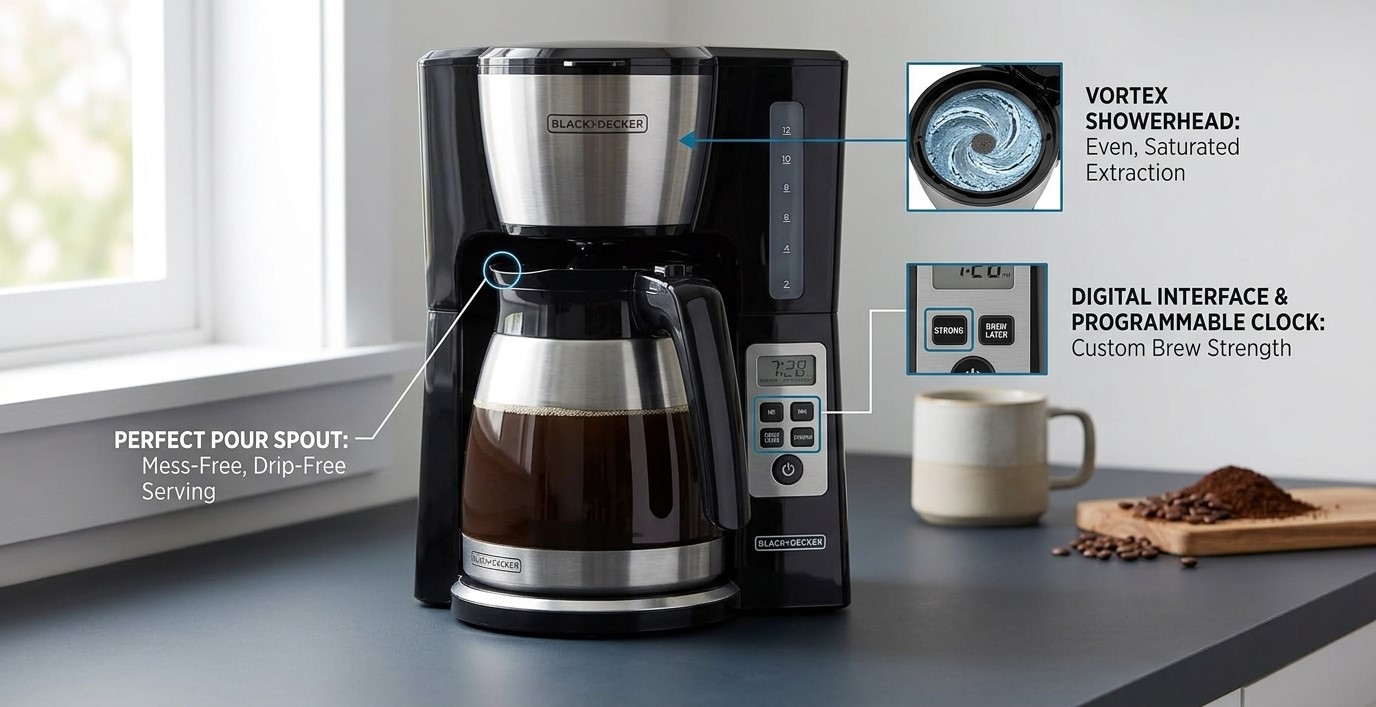
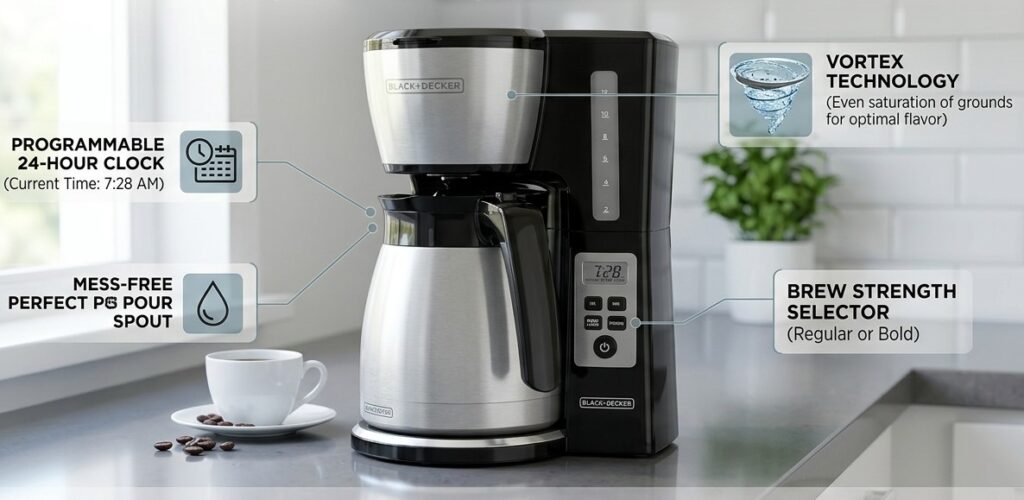
One of the defining features BLACK+DECKER highlights on this model is what it calls Vortex Technology — a showerhead design built into the brew basket area that’s meant to spread hot water more evenly across the coffee grounds as it drips through. In basic drip machines, water sometimes concentrates in the center of the grounds, which can lead to uneven extraction where some grounds are over-saturated and others barely touched. A wider, more even water distribution pattern is generally associated with more consistent flavor extraction across the entire pot, since more of the coffee bed gets contact with water at a similar rate.
Thermal Carafe with Vacuum Insulation
Rather than a glass carafe sitting on a hot plate, the CM2046S uses a stainless-steel thermal carafe built with vacuum-sealed insulation layers. According to the manufacturer, this design is intended to keep brewed coffee hot for up to two hours after brewing, while the exterior of the carafe stays cool enough to handle comfortably. This is a meaningful design choice for anyone who has dealt with the downsides of hot-plate coffee makers, where coffee left sitting for even 20 or 30 minutes can start to taste burnt or overly bitter from continued heat exposure. A sealed thermal carafe avoids that ongoing cooking process entirely, since heat is retained rather than reapplied.
Brew Strength Selector
Not everyone wants the same intensity of coffee, and the CM2046S includes a brew strength button that lets users choose between a standard brew and a stronger option. Selecting the stronger setting slows down the brewing process, which gives the water more contact time with the grounds and typically results in a fuller-bodied cup. This is a fairly common feature across mid-range programmable coffee makers, but it’s a useful one for households where preferences vary from one person to the next, or for anyone who simply wants more flexibility depending on the day.
Digital Programming and 24-Hour Delay Timer
The coffee maker includes digital controls with a delay-brew function, allowing users to set a specific time for brewing to start up to 24 hours in advance. This is the feature that makes “waking up to fresh coffee” possible — the machine can be loaded with water and grounds the night before, programmed for a set time, and left alone until it’s ready to brew on its own.
LCD Display with Fresh Brew Timer
Beyond the basic clock and programming display, the LCD screen on this model includes a fresh brew timer, which tracks and displays how much time has passed since the coffee finished brewing, up to 120 minutes. This is a small but practical touch for people who like to know whether their coffee has been sitting for five minutes or closer to two hours, especially since a thermal carafe doesn’t give off the same visual or smell cues that a hot plate does when coffee has been sitting too long.
No-Drip Perfect Pour Spout
The carafe’s spout is designed to reduce the dripping and minor spills that can happen with some pitcher-style carafes, particularly when pouring at an angle or filling a mug rather than a full-size cup. A cleaner pour matters more than it might sound like on paper — anyone who has dealt with coffee rings on a counter or a drip trail down the side of a carafe knows it’s a small but recurring annoyance.
Removable, Washable Brew Basket
The brew basket that holds the coffee grounds and filter is removable and washable, which makes daily cleanup more straightforward. Being able to pull the basket out, dump the grounds, and rinse it separately from the rest of the machine is a small convenience that adds up over regular, daily use.
Design and Build
The CM2046S has a black and stainless-steel exterior, which tends to blend fairly easily into most kitchen color schemes, whether the surrounding countertop or appliances lean modern, traditional, or somewhere in between. The 12-cup capacity is based on a standard coffee-maker “cup” measurement of approximately 5 ounces, which is worth keeping in mind since it doesn’t map directly onto a 12-ounce mug — more on that in the “Important Things to Consider” section below.
How It Can Be Used
A programmable thermal coffee maker like this one tends to fit naturally into a few different everyday routines, beyond the obvious “press a button and get coffee” use case.
Overnight programming for busy mornings. The most common use case is setting up the machine before bed — water in the reservoir, grounds in the basket — and programming the delay timer so brewing finishes right around when the household starts moving in the morning. Because the carafe is thermal rather than a hot plate, the coffee doesn’t need to be poured immediately or reheated; it can sit warm for a couple of hours while people get ready at their own pace.
Batch brewing for guests or gatherings. A 12-cup capacity is large enough to serve a small group, which makes this style of machine reasonably well suited to situations like a weekend brunch, a family visit, or a casual get-together where more than one or two people want coffee around the same time. Because the carafe holds heat without a burner, coffee brewed an hour before guests arrive can still be reasonably warm when it’s served.
Office or shared-space brewing. In a small office, shared workspace, or even a guest room in an Airbnb-style setup, a programmable thermal coffee maker can serve a similar function — coffee brewed early and available in decent condition for a few hours afterward, without someone needing to babysit it or keep restarting a hot plate.
Adjusting to different coffee occasions. The brew strength selector means the same machine can be used for a lighter, more approachable pot on some days and a bolder, more concentrated pot on others — useful for households where coffee preferences aren’t identical from person to person, or for someone who wants a stronger cup on a slow-starting morning and a gentler one later in the day.
Pairing with breakfast routines. Because brewing can be timed precisely, some people plan the coffee cycle around breakfast — for example, programming the machine to finish brewing right as something in the oven or on the stove is wrapping up, so both are ready around the same time without extra coordination.
Who It May Be Suitable For
This type of coffee maker tends to appeal most to a few overlapping groups of coffee drinkers:
- People who drink more than a cup or two at a time. With a 12-cup capacity, this machine is generally a better match for households or offices that go through multiple cups across a morning or afternoon, rather than someone who only wants a single cup and would prefer a smaller single-serve option.
- Anyone who dislikes hot-plate coffee makers. If you’ve noticed that coffee left on a hot plate starts tasting scorched or stale after sitting for a while, a vacuum-insulated thermal carafe addresses that specific complaint directly, since it holds heat without continuing to apply direct heat to the coffee itself.
- People who value routine and consistency. The programmable delay timer is most useful for people who have a fairly predictable daily schedule and like the idea of coffee being ready at a set time without manual intervention each morning.
- Households with mixed strength preferences. The brew strength selector gives some flexibility for people sharing a pot who don’t always want the same intensity.
- Small offices, guest rooms, or short-term rental setups. Because it brews a full carafe and keeps it warm without a burner, this style of machine can work well in settings where coffee needs to stay accessible and warm for a few hours without a lot of attention, such as a shared breakroom or a rental property amenity.
On the other hand, this style of machine may be less relevant for someone who exclusively drinks single cups on demand, prefers espresso-based drinks, or is looking for a compact footprint for a very small kitchen — those needs are generally better served by different categories of coffee equipment, discussed further below.
Important Things to Consider
Before deciding whether a coffee maker like this fits your kitchen, a few practical details are worth thinking through.
Cup size assumptions. The 12-cup rating is based on roughly 5-ounce servings, a standard convention across most drip coffee makers, not the actual capacity of a modern 12-ounce or larger mug. In practical terms, this means a “12-cup” pot will fill somewhat fewer standard mugs than the number might initially suggest — closer to six or seven full-size mugs rather than twelve. This isn’t unique to this model; it’s an industry-wide convention worth knowing regardless of which machine you’re considering.
Thermal carafes generally require hand washing. Vacuum-insulated stainless-steel carafes are typically not dishwasher-safe, since the sealed design and finish can be affected by the heat and detergent of a dishwasher cycle over time. Most manufacturers recommend hand washing the carafe with warm, soapy water. This is a minor extra step compared to a glass carafe, but it’s worth factoring into your cleaning routine.
Counter space and clearance. A 12-cup machine with a full-size carafe takes up more counter real estate than a compact single-serve brewer. It’s worth measuring the intended spot on your counter, including clearance for the reservoir lid to open for refilling, before assuming it will fit comfortably.
Descaling and mineral buildup. Like any drip coffee maker, performance and taste can be affected over time by mineral deposits from tap water, particularly in areas with hard water. Periodic descaling — typically with a water-and-vinegar solution or a dedicated descaling product — is generally recommended to keep the internal components working properly and to avoid a gradual decline in brewing performance.
It’s a drip brewer, not an espresso machine. Vortex Technology and the brew strength selector both aim to improve the quality and consistency of a standard drip-brewed pot, but this is fundamentally a drip coffee maker rather than an espresso or pressure-based brewing system. Anyone specifically looking for espresso, cortados, or similar concentrated drinks would need a different type of appliance entirely.
Warranty coverage. The CM2046S is generally covered by a limited warranty in the United States and Canada, and it’s worth registering the product and retaining proof of purchase in case service is ever needed. Warranty terms and coverage periods can change, so checking the current documentation at the time of purchase is a reasonable step.
Comparing General Categories of Coffee Makers
To put this type of machine in context, it helps to look at the broader landscape of home coffee brewing equipment without singling out any specific competing product.
Thermal carafe vs. glass carafe with hot plate. Glass carafe machines are typically less expensive and widely available, but they rely on a hot plate to keep coffee warm after brewing, which continues to apply heat to the coffee and can affect flavor over time — often described as a “cooked” or bitter taste developing the longer coffee sits. Thermal carafes, like the one used in this model, retain heat through insulation rather than ongoing heat application, which tends to preserve flavor for longer periods, generally at a somewhat higher price point than basic glass-carafe machines.
Drip machines vs. single-serve pod machines. Drip coffee makers, including this one, are generally better suited to brewing multiple cups at once and tend to offer more control over strength and, in some cases, bean or grind choice. Single-serve pod machines prioritize convenience and speed for one cup at a time but typically produce a smaller quantity per cycle and rely on pre-portioned pods rather than bulk coffee grounds, which can affect both cost per cup and the range of coffee options available.
Programmable vs. manual drip machines. Manual machines require someone to start the brew cycle directly, while programmable machines like the CM2046S allow brewing to be scheduled in advance. The trade-off is usually a slightly higher price and a small learning curve for using the digital controls, in exchange for the convenience of scheduled brewing.
Capacity tiers. Coffee makers generally fall into small-batch (around 4 to 6 cups), mid-size (around 8 to 10 cups), and larger 12-cup-plus categories. Smaller machines suit individuals or couples who don’t need a full pot at once, while larger-capacity machines like this one are generally aimed at households or settings where multiple people are likely to want coffee around the same time.
Each of these categories serves a different set of priorities — convenience, batch size, flavor preservation, or simplicity — and there isn’t a single “correct” choice across the board. The right fit really comes down to how much coffee you typically make, how long it needs to stay warm, and how much daily involvement you want in the brewing process.
Frequently Asked Questions
Does this coffee maker need paper filters, or does it use a reusable filter? The CM2046S includes a removable, washable brew basket. Specific filter compatibility (paper vs. permanent filter) can vary by unit and packaging, so it’s a good idea to check the included manual or product listing for exact filter details before your first brew.
How long does the thermal carafe actually keep coffee hot? According to the manufacturer, the vacuum-insulated carafe is designed to maintain optimal serving temperature for up to two hours after brewing. Actual results can vary somewhat depending on ambient room temperature and how full the carafe is.
Can I brew a smaller amount, like 4 or 6 cups, instead of a full pot? Most drip machines in this category, including standard 12-cup models, are designed primarily around full or near-full brew cycles rather than precise small-batch settings. If brewing very small amounts frequently is a priority, it’s worth checking the specific product documentation to see whether reduced-capacity brewing is supported or recommended.
Is the carafe dishwasher safe? Vacuum-insulated stainless-steel thermal carafes are typically hand-wash only, since dishwasher heat and detergents can affect the seal and finish over time. Checking the care instructions included with the unit is the best way to confirm proper cleaning steps.
What does the “brew strength” setting actually change? Selecting the stronger brew option slows the brewing process, extending water contact time with the coffee grounds, which generally produces a bolder, fuller-bodied cup compared to the standard setting.
How far in advance can I program the coffee maker to brew? The digital controls include a delay-brew function that allows scheduling up to 24 hours ahead, which is what enables the “set it up the night before” style of use that many people rely on for morning coffee.
Does the machine have a water filtration system built in? This model focuses on brewing technology (the Vortex showerhead system) and heat retention (the thermal carafe) rather than integrated water filtration. Using filtered water in the reservoir is generally a good practice for flavor and to help reduce mineral buildup over time, regardless of which coffee maker you’re using.
What’s included in the box? Based on manufacturer information, the coffee maker typically comes with the stainless-steel thermal carafe and the removable, washable brew basket, along with the base unit itself and included documentation.
Conclusion
The BLACK+DECKER CM2046S brings together a handful of practical features — a vacuum-insulated thermal carafe, an evenly distributing Vortex showerhead system, adjustable brew strength, 24-hour programmability, and a drip-resistant pour spout — into a fairly standard 12-cup drip coffee maker format. None of these features are entirely unique to this model individually, but together they represent a fairly complete package for anyone specifically looking for a programmable, thermal-carafe coffee maker rather than a glass-carafe, hot-plate style machine or a single-serve system.
Whether it’s the right fit really depends on your household’s coffee habits: how much you typically brew at once, how long it needs to stay warm, how much you value scheduling flexibility, and how you feel about the slightly extra step of hand-washing a thermal carafe. Weighing those everyday details against the features outlined here should make it easier to judge whether this coffee maker lines up with how you actually want your mornings to go.